
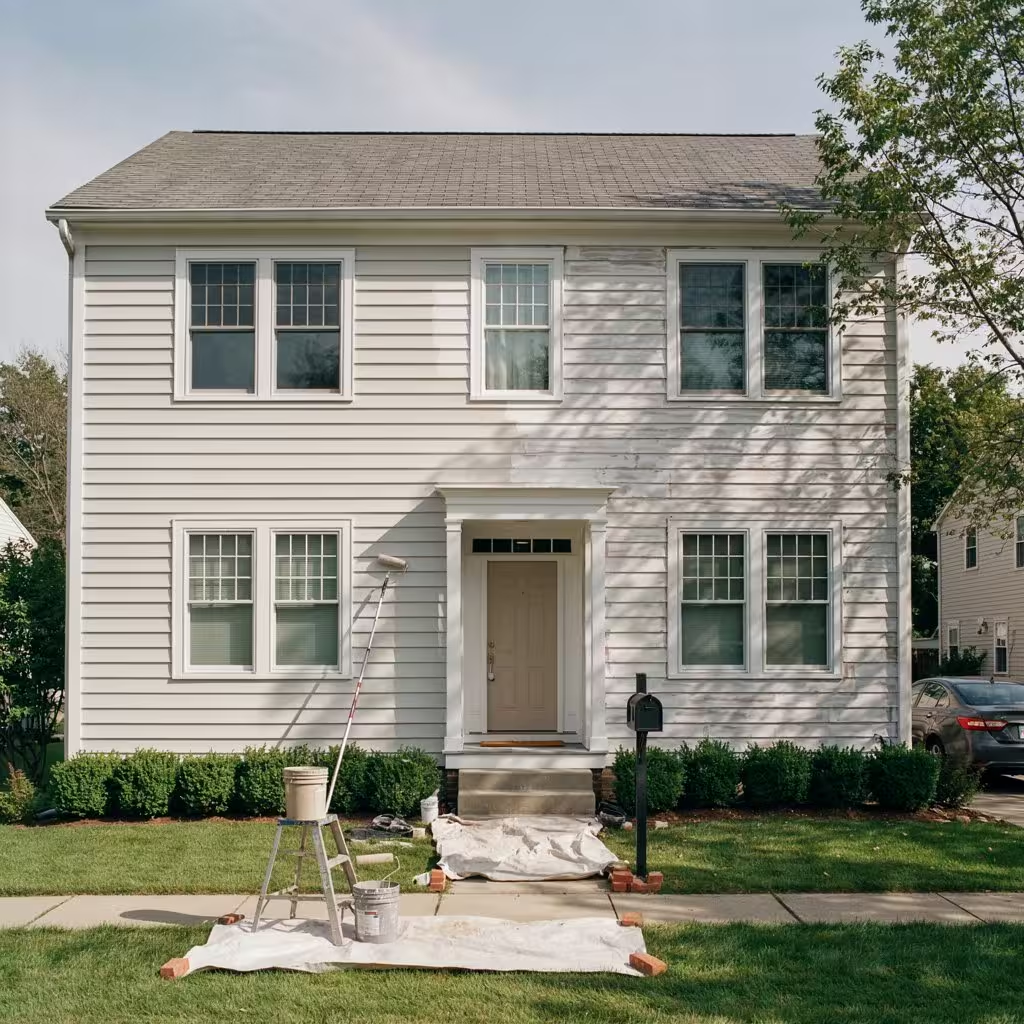
Vinyl cladding is engineered to never need paint that’s the whole sales pitch. But after fifteen or twenty years of UV exposure, most panels fade, chalk, or simply go out of style, and replacement isn’t always in the budget. So the question I get asked on almost every second site visit is some version of: “Can I just paint this instead of tearing it off?”
Short answer: yes, in most cases you can paint vinyl cladding but only with the right paint chemistry, the right color range, and realistic expectations about how long it will last. Get any one of those three wrong and you’ll be dealing with warped panels, peeling paint, or a voided warranty within a year or two. Get them right, and a painted vinyl exterior can look sharp for 7–10 years at a fraction of the cost of a full re-clad.
This guide walks through everything a homeowner actually needs to know before picking up a roller, not just whether it’s possible, but the physics, the product selection, the cost math, and the mistakes that ruin most DIY vinyl paint jobs.
| Question | Short Answer |
| Can you paint vinyl cladding? | Yes, if it’s structurally sound, clean, and painted with 100% acrylic exterior paint rated for vinyl. |
| Does it void the warranty? | Often, yes most manufacturers’ fade and material warranties exclude painted panels. Check your paperwork first. |
| Can you go dark? | Only with vinyl-safe formulations that limit LRV drops, and even then, darker than original is risky. |
| How long does it last? | 5–10 years, depending on climate, prep quality, and paint grade. |
| Do you need primer? | Usually not with true vinyl-safe acrylics — but a bonding primer helps on chalky, faded, or glossy panels. |
| Paint or replace? | Paint if the cladding is sound and you need 5–10 more years; replace if panels are cracked, warped, or brittle. |
What Is Vinyl Cladding, and Why Painting It Is Different From Painting Wood
Vinyl cladding (also called vinyl siding) is extruded PVC polyvinyl chloride formulated with UV stabilisers and colour pigment baked all the way through the material, not just on the surface. That’s important, because it explains almost every rule in this guide.
Wood and fibre cement expand and contract with moisture. Vinyl expands and contracts with heat, and it moves a lot more than people expect. A 12-foot panel of vinyl siding can grow or shrink by close to half an inch between a cold morning and a hot afternoon. Manufacturers build “expansion gaps” and floating nail slots into every panel specifically to let this movement happen without buckling.
Paint doesn’t move the same way vinyl does. A rigid, ordinary exterior paint film will crack at the seams as the panel flexes underneath it. That single fact is the reason vinyl-specific paint exists, why dark colours are restricted, and why generic “exterior latex” from the discount aisle is the number one cause of failed vinyl paint jobs.
Does Painting Vinyl Cladding Void the Warranty?
This is the question that stops most homeowners in their tracks, and it deserves a straight answer: painting vinyl cladding frequently voids the manufacturer’s warranty, because most vinyl warranties only cover the factory finish not anything applied afterward. Once you paint over that factory color, you’ve created a new, unwarranted surface, even if the vinyl itself is still sound.
A few things worth knowing before you assume the worst:
- Read the actual document, not the marketing page. Some manufacturers only exclude fade and color warranty claims after painting, while structural or hail-damage coverage stays intact. Others void the entire warranty outright.
- Painting doesn’t usually violate building codes or HOA rules by itself — but HOAs frequently have their own separate color and material restrictions that are stricter than the manufacturer’s. Check both.
- If your cladding is already out of its warranty period (often 25–50 years, though the full-replacement portion is frequently much shorter, sometimes 5–10 years), this becomes a non-issue.
- Get it in writing if it matters. Call the manufacturer directly and ask them to confirm in writing whether painting affects your specific warranty class before you start.
Bottom line: don’t take any blog’s word for it, including this one pull your specific product’s warranty document or call the manufacturer. The variation between brands is real enough that a blanket “it’s fine” or “it’s not” answer would be dishonest.
What Is the Best Paint for Vinyl Cladding?
This is where most DIY jobs go wrong before the roller ever touches the wall. Vinyl needs a specific paint chemistry, not just a specific brand.
The non-negotiable: 100% acrylic latex, labelled “vinyl-safe”
Look for the words “100% acrylic” and ideally a specific vinyl-siding or vinyl-safe designation on the can. This isn’t marketing fluff — it describes real differences in the resin:
- 100% acrylic resins stay elastic across a wide temperature range, so the paint film can move with the vinyl instead of cracking at it.
- Adhesion to plastic. Vinyl is a low-surface-energy plastic. Cheaper vinyl-acrylic blends don’t bond to it well and peel within a season or two.
- UV and heat stability. Vinyl-rated lines use pigment and resin systems engineered to survive the heat buildup dark and mid-tone colors absorb.
Paint type comparison
| Paint Type | Works on Vinyl? | Notes |
| 100% acrylic latex (vinyl-safe line) | Yes best option | Flexes with panel movement, bonds to plastic, holds color |
| Vinyl-acrylic blend (budget latex) | Not recommended | Poor adhesion to PVC, chalks and peels early |
| Oil-based / alkyd | No | Goes brittle, cracks as vinyl expands and contracts |
| Elastomeric coating | Situational | Very flexible, good on damaged/chalky panels, but expensive and changes texture |
| Solar-reflective “cool” acrylic | Yes — trending upward | Ceramic/infrared-reflective pigments allow darker colors with lower heat absorption |
Major manufacturers with dedicated vinyl-safe product lines include Sherwin-Williams (VinylSafe), Benjamin Moore, PPG, and Behr each publishes an approved color palette engineered around safe LRV ranges for their formulation. Buying from that specific palette, rather than colour-matching an arbitrary swatch into a vinyl-safe base, is the safest route.
Can You Paint Vinyl Cladding a Dark Color?
Technically yes, but this is the single most common way homeowners wreck a paint job, so it deserves its own section rather than a footnote.
The physics in plain terms
Color determines how much solar energy a surface absorbs. That’s measured as Light Reflectance Value (LRV) — a 0–100 scale where 100 reflects nearly all light (bright white) and 0 absorbs nearly all of it (true black). Vinyl cladding was originally formulated and warrantied around a fairly narrow LRV band, historically often cited around LRV 55 and above, because darker, lower-LRV colors push surface temperatures high enough to cause:
- Warping and buckling, especially on south- and west-facing walls with full afternoon sun
- Panel distortion at the locking edges, which then telegraphs as visible waviness across a whole wall
- Accelerated paint film breakdown from repeated heat cycling
What’s changed the LRV rule
This is a genuine trend worth flagging, and something most competing articles miss entirely: solar-reflective pigment technology has loosened the old LRV 55 rule of thumb. Vinyl-safe paint lines increasingly use infrared-reflective or “cool colour” pigments that reflect more heat than a traditional pigment of the same visible colour. Some manufacturers now approve specific darker colours down toward LRV 40 or occasionally lower within their own vinyl-safe line only, provided the panel is also a heat-resistant vinyl formulation to match.
Practical takeaway: never go by a paint chip alone. Cross-check the LRV number printed on the vinyl-safe fan deck against your paint brand’s published minimum LRV for your specific cladding profile and exposure, and lean lighter on any wall that gets several hours of direct afternoon sun.
How Long Does Painted Vinyl Cladding Last?
Set expectations before you start, because “how long will this hold up” is the most common source of buyer’s remorse with painted vinyl.
Realistic lifespan: 5–10 years, with the spread driven almost entirely by four variables:
- Prep quality Chalking (the powdery residue on aged vinyl) has to be fully removed, or paint bonds to the chalk layer instead of the panel and fails early.
- Paint grade True 100% acrylic vinyl-safe products consistently outperform blended or generic exterior latex by several years.
- Color/LRV choice Staying within the manufacturer’s approved LRV range measurably extends film life versus pushing into a color that runs hot.
- Exposure South- and west-facing walls, and homes in hot climates generally, will land at the shorter end of that range; shaded, cooler-climate walls will land at the longer end.
Compare that to unpainted factory-finish vinyl, which typically holds usable color for 20–40+ years, and it’s clear painting is a maintenance decision, not a permanent upgrade. You’re buying time and curb appeal, not resetting the material’s lifespan.
Do You Need to Prime Vinyl Before Painting?
The honest answer is “it depends on the panel’s condition,” which most guides skip past.
Skip primer when:
- The vinyl is clean, sound, and only mildly faded
- You’re using a true 100% acrylic vinyl-safe paint (many are formulated to self-prime on sound vinyl)
Use a bonding primer when:
- The surface is chalky even after washing (do the hand-wipe test run a dark cloth across the panel; heavy white residue means chalking)
- The existing finish is glossy or slick
- You’re covering a significant colour change, especially light-to-dark, where hide and adhesion both benefit from a primer coat
- Repairs, patches, or caulked seams are present and need a uniform base
A bonding primer formulated for plastics, not a generic drywall or wood primer, is essential in every one of those cases. General-purpose primers don’t adhere to PVC any better than general-purpose paint does.
Paint or Replace? The Real Cost-vs-Value Breakdown
This is the comparison most readers actually came here to make, so let’s put real numbers next to real trade-offs.
| Factor | Paint Vinyl Cladding | Replace Vinyl Cladding |
| Typical cost (average home) | $500–$1,200 DIY materials, or ~$2–$5/sq ft professionally installed | Often $8–$14+/sq ft installed |
| Lifespan of the fix | 5–10 years | 20–40+ years |
| Warranty impact | Often voids fade/color warranty | New full warranty on new material |
| Fixes structural damage? | No cracked/warped panels still need replacing first | Yes |
| Disruption | Low days, home stays livable | Higher days to weeks, more noise/debris |
| Best for | Sound cladding that’s simply faded or dated in color | Cracked, warped, brittle, or moisture-compromised cladding |
Rule of thumb I give clients: if more than roughly 10–15% of your cladding shows cracking, warping, or brittleness, replacement almost always wins on cost per year even though the upfront number is higher. If the material is structurally fine and this is purely a colour/fade problem, painting is the better-value move.
Signs Your Cladding Should NOT Be Painted
Skipping this check is the second-biggest cause of failed jobs after wrong paint chemistry. Walk the exterior and look for:
- Brittleness: press gently on a panel edge; if it feels stiff and prone to snapping rather than flexing slightly, the plastic has UV-degraded and paint won’t save it
- Existing cracks or splits, even hairline ones – these will telegraph through paint and widen with the next heat cycle
- Visible warping or waviness along a wall is a sign the panel has already experienced heat distortion; painting adds more heat absorption risk, not less
- Active moisture problems behind the cladding paint is cosmetic and do nothing for rot, mould, or water intrusion happening underneath
- Loose or improperly hung panels fix the installation before you spend money on finish
If any of these show up, the honest recommendation is targeted panel replacement or a full re-clad, not paint.
Step-by-Step: How to Paint Vinyl Cladding Properly
- Inspect first. Walk the whole exterior and flag anything from the list above before buying a single can of paint.
- Wash thoroughly. A mild detergent solution and a soft-bristle brush, or a low-pressure wash, remove dirt, chalk, mildew, and salt residue. Trisodium phosphate (TSP) or a TSP substitute cuts chalking especially well; rinse it completely.
- Let it dry fully. 24–48 hours minimum, longer in humid climates, before any paint or primer goes on.
- Do the chalk test. Wipe a dark cloth across several panels. Heavy residue means you need a bonding primer, not just a wash.
- Repair and caulk. Fill cracks and gaps with a flexible exterior caulk rated for vinyl; rigid fillers will crack again at the first heat cycle.
- Mask and protect. Windows, trim, fixtures, and landscaping.
- Prime if needed, using a plastic-bonding primer.
- Apply two thin coats of 100% acrylic vinyl-safe paint, allowing full recoat time between coats per the can’s data sheet. Two thin coats consistently outperform one heavy coat.
- Work within the temperature window (see below) and avoid direct midday sun, which can cause the paint to dry too fast for proper film formation.
- Plan for maintenance, not a “paint it and forget it” outcome. See the maintenance section below.
Sprayer vs. Roller vs. Brush
| Method | Best For | Trade-off |
| Airless sprayer | Large, uninterrupted wall sections; most even, factory-like finish | Needs extensive masking; overspray risk; steeper learning curve |
| Roller | Most DIY jobs; good coverage on lapped siding profiles | Slower than spraying; texture slightly less uniform |
| Brush | Trim, corners, detail work, cutting in | Slowest for large areas; essential companion tool regardless of method |
Most professional crews spray the field and brush or roll the detail work a hybrid approach that gets speed and finish quality without the masking headaches of spraying an entire home solo.
Temperature and Weather: The Window Nobody Talks About Enough
Vinyl paint has a genuinely narrow application window, and this is one of the most under-covered details in most guides on this topic.
- Air and surface temperature generally need to stay within roughly 50–85°F (10–29°C) during application and while the paint cures — check your specific product’s data sheet, since ranges vary by brand and formulation.
- Surface temperature, not just air temperature, matters. A wall in direct sun can be 20–40°F hotter than the surrounding air, which can push it outside the paint’s workable range even on a mild day. Many pros paint the shaded side of the house in the morning and the sunny side later, chasing the shade around the building.
- Avoid painting in direct, high-intensity sun even within the temperature range — it causes the surface to skin over too fast, trapping solvent and weakening the film.
- Humidity and dew point matter for cure time. High humidity slows drying and can cause blushing or poor film formation; check overnight lows too, since dew forming on a not-yet-cured coat can ruin the finish.
- Wind above roughly 15 mph makes overspray and even brush/roller application unpredictable, and accelerates uneven drying.
Treat the paint can’s data sheet as the final authority, but the general principle holds across every vinyl-safe product: paint in mild, shaded, low-wind conditions, not the hottest or coldest days of the season.
Maintenance and Recoat Expectations
Painting vinyl converts a low-maintenance material into a maintained one worth saying plainly, because it changes the ongoing cost picture:
- Rinse annually to prevent chalking and dirt buildup from shortening the paint’s life.
- Spot-check south and west walls yearly for early fading or chalking, since these age faster than shaded elevations.
- Budget for a coat around years 7–10, sooner in hot climates or on dark colours, or later on light colours in mild climates.
- Touch up promptly small chips or scuffs left exposed let moisture get under the paint film and spread the failure.
Pros and Cons of Painting Vinyl Cladding
Pros
- Meaningfully cheaper than replacement when cladding is structurally sound
- Fast, visible curb-appeal change, often finished in days rather than weeks
- Lets you update a dated or faded colour without demolition waste
- Buys years of usable life out of otherwise sound material
Cons
- Frequently voids manufacturer fade/colour warranty
- Finite lifespan (5–10 years) compared to unpainted vinyl’s decades-long colour life
- Wrong paint chemistry or wrong colour choice can cause visible, sometimes irreversible warping
- Converts a “never needs maintenance” material into one that needs periodic recoating
- Does nothing to fix underlying structural, moisture, or installation problems
2026 Trends in Vinyl Cladding Painting
- Solar-reflective pigment technology is the biggest shift in the category it’s steadily expanding how dark homeowners can realistically go without the old warping risk, and every major vinyl-safe line now markets some version of it.
- Low-VOC and water-based formulations have become the default even in “premium” vinyl-safe lines, driven by both regulation and homeowner demand.
- Warmer, earthier neutral palettes (greige, warm taupe, deep but reflective greens) are outpacing stark white and cool gray in vinyl-safe color charts, partly because they sit in more forgiving LRV ranges than true charcoal or black.
- Growing awareness of the warranty trade-off more homeowners are calling manufacturers directly before painting rather than assuming coverage either way.
Professional spray application demand is rising relative to DIY rolling, as more paint brands publish spray-specific application guides for vinyl-safe lines.
Final Word From the Field
Painting vinyl cladding is a legitimate, cost-effective move when the panels are sound and you respect the material’s rules. The jobs that fail almost always trace back to one of three shortcuts: cheap paint that isn’t truly vinyl-rated, a color pushed too dark for the LRV the material can handle, or prep work rushed past chalking and cracks that needed attention first. Slow down on those three decisions and a painted vinyl exterior will comfortably buy you 5–10 good years and a real curb-appeal reset for a fraction of what a full re-clad costs.