Your living room sounds like a swimming pool. You say “pass the salt” and the walls say it back twice. Bare drywall, hard floors, and zero sound control will do that. An acoustic wall panel fixes the echo, and this guide shows you how to buy the right one.
In 2026, AI search tools and generative answers favor pages that give direct, checkable answers. So we skip the fluff and give you real numbers, simple formulas, and plain steps. You’ll learn how NRC ratings work, how much wall to cover, and which material fits your room. You won’t pay for panels you don’t need, either.
Casa Direct wrote this guide for buyers who want facts before they spend money. Let’s get into it.
Key Takeaways
- Panels absorb sound inside a room. They cut echo but don’t block noise.
- Aim for NRC 0.7 or higher. Home theaters and studios should push toward 0.9.
- Cover 15 to 25 percent of wall area for echo control, and 30 to 40 percent for studios.
- Fabric-wrapped fiberglass absorbs the most sound. PET felt suits offices, and wood slats suit lobbies.
- Check the mounting type and the full frequency chart, since NRC alone hides weak bass.
- Most buyers can install panels themselves, then vacuum them every few weeks with low suction.
What Acoustic Wall Panels Actually Work? (Sound Absorption vs. Soundproofing)
Most buyers mix up two different jobs. Soundproofing blocks sound from crossing a wall. Sound absorption soaks up sound inside a room so it stops bouncing around. An acoustic wall panel does the second job only.
Blocking sound takes mass, airtight seals, and decoupled framing. A standard drywall wall earns an STC rating of about 33 to 35, and a thin panel adds almost nothing to that number. Panels work through porous materials instead. Sound waves enter the fibers, rub against them, and turn into tiny amounts of heat. Less energy bounces back, so echo drops.
You measure that drop as reverberation time, or RT60. It tracks how long sound takes to fade by 60 decibels. A bare room can run 1.0 second or more, while most homes sound best between 0.3 and 0.6 seconds. Speech gets clearer, music gets sharper, and video calls stop sounding like a cave. If you want to silence the neighbor’s drum set, panels won’t help. If you want a calmer room, they’re the right tool.
Types of Acoustic Panels: Materials, Finishes, and Best Use Cases
Three materials dominate the market, and each one behaves differently.
PET felt panels use polyester fiber, often made from recycled plastic bottles. They’re light, resist moisture, and come in thicknesses from 9 mm to 25 mm. Expect NRC values around 0.4 to 0.7. They suit offices, bedrooms, and small studios.
Fabric wrapped fiberglass panels pack rigid fiberglass board inside a frame and cover it with acoustic fabric. A 2 inch panel often reaches NRC 0.9 to 1.0. That makes it the top performer for home theaters, podcast rooms, and conference rooms.
Wood slat panels bond wood strips over an acoustic felt backing. They look sharp in lobbies and dining rooms. NRC usually lands between 0.4 and 0.8, and the felt does the real absorbing.
Foam wedges cost less, but they mostly tame high frequencies. Skip them if you care about speech clarity or music. Match the material to the job before you fall for a finish.
Acoustic Wall Panel Materials Compared
| Material | Typical NRC | Best for | Typical price per sq ft | Watch out for |
| PET felt | 0.4 to 0.7 | Offices, bedrooms, small studios | $3 to $8 | Thin panels give less bass control |
| Fabric wrapped fiberglass | 0.9 to 1.0 (2 inch) | Home theaters, podcast rooms, conference rooms | $8 to $20 | Needs acoustically transparent fabric and a dry room |
| Wood slat | 0.4 to 0.8 | Lobbies, dining rooms | $20 to $50 | The felt backing does the real absorbing |
Understanding NRC Ratings: How to Measure Acoustic Performance
NRC stands for Noise Reduction Coefficient. Labs test a material under ASTM C423, measure absorption at 250, 500, 1000, and 2000 Hz, then average the results and round to the nearest 0.05. The scale runs from 0.0 to 1.0. A rating of 0.0 reflects everything. A rating of 0.8 absorbs about 80 percent of the sound energy that hits it.
For most rooms, aim for NRC 0.7 or higher. Home theaters and recording spaces should push toward 0.9 or more. Anything under 0.5 handles light echo at best.
Read the fine print, though. NRC averages only four frequencies, so it can hide weak bass performance. Ask for the full sound absorption coefficient chart from 125 Hz to 4000 Hz. Also check the mounting type. Type A means the panel sits flat on a surface, while Type E leaves an air gap behind it. The same panel scores higher with a gap. Compare panels only when they share the same mounting.
How Many Panels Do You Need? Calculating Coverage for Any Room
Every buyer asks this question. Start with a simple rule. Cover 15 to 25 percent of your total wall area for light echo control. Studios and theaters need 30 to 40 per cent.
Now do the math. Say your room measures 15 by 12 feet with 8-foot ceilings. Wall area equals 2 × (15 + 12) × 8, which gives 432 square feet. Twenty percent of that is about 86 square feet. A 2 by 4 foot panel covers 8 square feet, so you need roughly 11 panels.
Want more precision? Use the Sabine formula. RT60 equals 0.049 times room volume in cubic feet, divided by total absorption in sabins. Your room holds 1,440 cubic feet. A 0.5-second target needs about 141 seconds. Subtract what carpet, curtains, and furniture already give. Then divide the gap by 7.2 sabins per panel, which is 8 square feet times NRC 0.9.
Place panels at first reflection points, usually side walls at ear height.
Design and Aesthetics: Blending Function with Your Interior Style
Acoustic panels don’t have to look like a recording booth. Pick the finish first, because the finish shapes how the room feels.
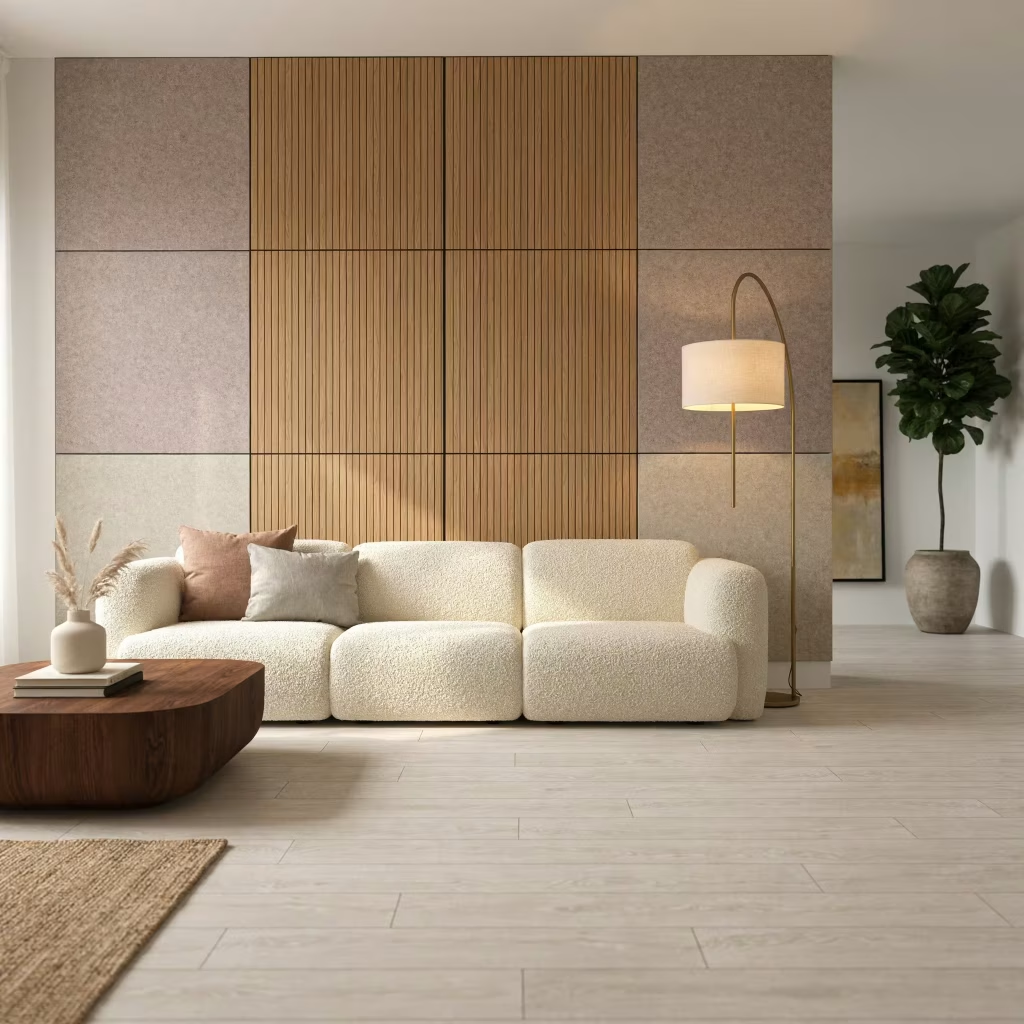
Fabric-wrapped panels come in dozens of solid colours, and printed versions carry photos or artwork. Light fabrics bounce more light around, which helps dark rooms. Wood slats pair well with mid-century and modern interiors. Felt panels cut into shapes work as wall art in offices and kids’ rooms.
Here’s a trick. Place panels where sound reflects, not just where they look neat. Spread them across two adjacent walls, since sound bounces from corner to corner. Mix panel sizes for rhythm. Leave some wall bare, and the room still reads as designed.
Watch the fabric, too. Acoustically transparent fabric lets sound pass through to the core. Tightly woven or coated fabric blocks it and cuts performance. Always confirm your fabric is acoustically transparent before you order.
Installation, Maintenance, and Budgeting: What to Know Before You Buy
Installation is easier than most people expect. Panels mount with adhesive strips, Z clips, or screws into studs. Adhesive suits light felt on painted drywall. Heavy fibreglass panels need clips or screws, so grab a stud finder. Mark your spacing with painter’s tape and check it with a level before you commit.
Maintenance takes five minutes. Vacuum with a soft brush attachment on low suction every few weeks. Spot clean fabric with a damp cloth. Never soak a panel, since moisture ruins fibreglass and felt.
Budget with real numbers. Typical retail prices run roughly $3 to $8 per square foot for PET felt, $8 to $20 for fabric wrapped fiberglass, and $20 to $50 for wood slats. Our 86-square-foot example room lands near $700 to $1,700 with fabric wrapped panels. Add a little extra for mounting hardware, and you’re set.
The Big Picture
Echo doesn’t have to run your room. Pick the right acoustic wall panel, check the NRC rating, and cover the right amount of wall.
You’ll hear the difference fast. Ready to start? Contact Casa Direct, and we’ll help you choose panels that fit your space.
Ready to Quiet Your Room?
Talk to the Casa Direct team. Share your room size and goals, and we’ll help you pick the right acoustic wall panel, thickness, and coverage. Request a quote today and stop shouting over your own echo.