Quick answer: In the MDF vs plywood cabinets debate, plywood is the better choice for cabinet boxes, especially around sinks and in humid climates, because it holds screws better and handles moisture more safely. MDF is the better choice for painted doors, because its smooth, grain-free surface gives a flawless finish. Many quality kitchens use both: plywood boxes with MDF doors. Particleboard is a third option, usually the lowest-cost and least moisture-tolerant of the three.
MDF vs plywood cabinets is one of the most common questions homeowners ask when they compare quotes, and it is also one of the most misunderstood. Many guides crown a single winner. In practice, the smarter question is not “which material is better?” but “which material is better for each part of the cabinet?” This guide explains how both materials are made, how they perform, what they cost and how to choose for your home, so you can read a quote with confidence.
What Are MDF Cabinets?
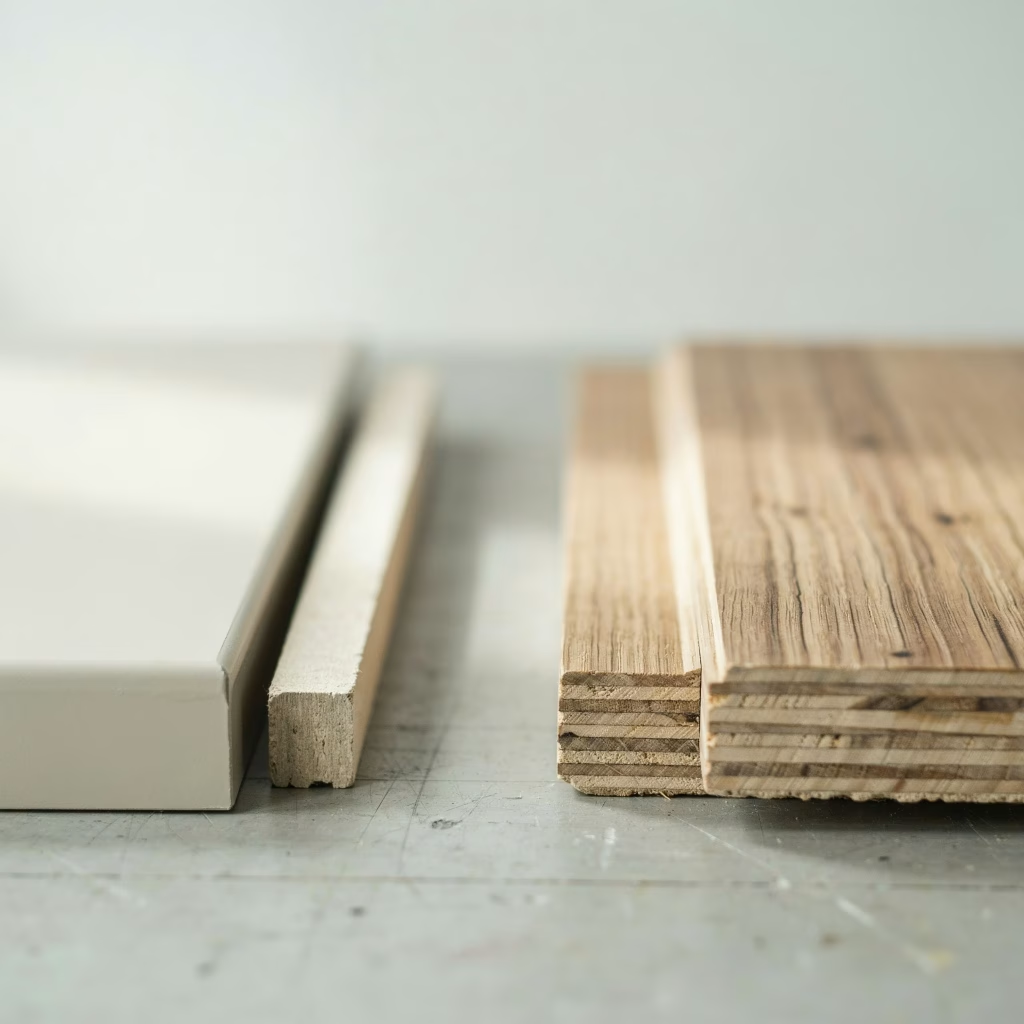
MDF cabinets are made with medium-density fibreboard, an engineered panel created by pressing fine wood fibers and resin together under heat and pressure. The result is a dense, smooth, uniform sheet with no grain and no knots.
Because the surface is so even, MDF is widely used for painted cabinet doors, routed profiles and decorative panels. It is also commonly used as a core under veneer or laminate.
What Are Plywood Cabinets?
Plywood cabinets are built from thin layers of real wood veneer glued together with the grain of each layer running in alternating directions. This cross-layer construction gives plywood its strength and stability.
Plywood is available in different grades and core types, so quality varies. A well-made hardwood plywood panel behaves very differently from a low-grade panel with gaps inside, which is why asking about the specific panel matters.
MDF vs Plywood Cabinets at a Glance
| Factor | MDF | Plywood |
|---|---|---|
| Material | Wood fibers and resin | Layered wood veneers |
| Surface | Very smooth, no grain | Visible grain, edge layers show |
| Moisture resistance | Weak, edges swell if exposed | Better, but not waterproof |
| Screw holding | Fair, weakens if screws are re-driven | Strong |
| Weight | Heavier | Lighter |
| Best for painted finishes | Excellent | Good, grain may show through |
| Shelf sag over long spans | More likely | Less likely |
| Typical cost | Generally lower | Generally higher |
Plywood vs MDF: Durability and Strength
Plywood vs MDF durability comes down to structure. Plywood’s cross-laminated layers resist warping and hold screws and hinges well, even after repeated adjustment. That matters for cabinets, because doors are opened thousands of times and hinges carry real load.
MDF is dense and stable, but it has no grain to grip fasteners. Screws hold well the first time, yet they can loosen if a hinge is removed and reinstalled in the same hole. Long MDF shelves can also sag under heavy loads such as stacked dishes or small appliances, so they need adequate support.
A simple rule: the more structural stress a part carries, the more it favours plywood.
Moisture Resistance The Biggest Real-World Difference
Moisture resistance is where the two materials separate most clearly. Kitchens deal with steam, splashes, dishwasher heat and the occasional leak.
- MDF absorbs water through unsealed edges and swells. Once swollen, it usually does not return to its original shape.
- Plywood can also be damaged by long exposure to water, but it tends to tolerate brief moisture better and is less prone to dramatic swelling.
- Sealing matters for both. Factory-applied finishes, edge banding and sealed cutouts all help. Ask how the sink-base cutouts and bottom edges are sealed.
Neither material is waterproof. If you want maximum protection under the sink, choose plywood for the base cabinet and keep a leak tray or water sensor in place.
Finish Quality and Painted Cabinet Doors
For painted cabinet doors, MDF has a real advantage. Its uniform surface does not telegraph wood grain, so paint goes on smooth, and routed Shaker profiles come out crisp. This is why many premium painted kitchens use MDF doors on purpose, not just to save money.
Plywood works well for stained or natural wood finishes, where visible grain is part of the look. Painted plywood can still look good, but a quality finisher needs to fill and sand the grain.
If you are choosing a door style, our shaker vs slab cabinets guide shows how each profile looks in different finishes. If you plan to refinish later, read how to paint kitchen cabinets before you decide.
Kitchen Cabinet Cost: MDF vs Plywood
Kitchen cabinet cost depends on much more than the core material, but material choice does move the price. In general:
- MDF is usually less expensive per panel, so MDF-based lines tend to come in lower.
- Plywood boxes usually raise the cost of a cabinet line, though the gap depends on grade, thickness and manufacturer.
- Hybrid builds (plywood boxes with MDF doors) often balance price and performance.
- Finish, hardware and tier can change the price more than the core does.
Region also matters. Labor rates, shipping costs and local supply vary by city and state, and heavier MDF panels can add freight cost on large orders. Always request itemized quotes and ask suppliers to list the box material, door material and shelf material separately. Our modern kitchen design cost guide shows how cabinets fit into the full budget, and the semi-custom cabinets buying guide explains how cabinet tiers affect price.
Does Your Climate or City Change the Choice?
Yes, in practical terms. Humidity and water exposure change how much risk you take on.
- Humid or coastal regions (such as parts of the Gulf Coast and Southeast) put more stress on cabinet edges, so plywood boxes are a safer bet.
- Dry climates reduce the moisture risk, though sink areas still need protection.
- Older homes and homes with past plumbing issues benefit from plywood in base cabinets.
- Condos and apartments with shared plumbing walls may justify extra protection under sinks.
These are general tendencies, not rules, so ask your local installer how each material has held up in your area.
Choose by Part, Not by Brand Claim
This is the approach many buyers miss. Instead of choosing one material for the entire kitchen, match the material to the job:
- Sink base and dishwasher-adjacent cabinets: plywood
- Cabinet boxes in general: plywood if budget allows, quality particleboard or MDF in lower-risk areas
- Painted doors and drawer fronts: MDF, or a veneered MDF core
- Long shelves and heavy loads: plywood, or MDF with support rails
- Wall cabinets away from water: either material works when well built
- Stained wood-grain doors: real wood veneer over a plywood or MDF core, depending on the line
This part-by-part approach often gives better performance per dollar than paying for plywood everywhere.
Where Does Particleboard Fit?
Many quotes mention a third material. Particleboard is made from wood chips and resin. It is typically the lowest-cost option, and it is commonly used for budget cabinet boxes and shelves. It can work well in dry areas when it is properly laminated and sealed, but it is generally the least forgiving when exposed to moisture. If a quote does not specify the box material, ask directly.
Health and Compliance: Look for Formaldehyde Labels
Both MDF and many plywood products use resins that can emit formaldehyde. In the United States, composite wood panels sold for cabinetry are regulated, and compliant products carry labeling such as CARB Phase 2 or EPA TSCA Title VI. Ask your supplier for the compliance label or documentation, especially if you have chemically sensitive family members. For lower-emission options, ask about panels made with no-added-formaldehyde resins.
Pros and Cons Summary
MDF cabinets
- Pros: smooth surface, excellent for painted finishes, stable, usually lower cost
- Cons: swells when wet, weaker screw hold over time, heavier, can sag on long shelves
Plywood cabinets
- Pros: strong screw hold, lighter, better moisture tolerance, durable for boxes
- Cons: typically higher cost, visible grain and edge layers, quality varies by grade
How to Check Quality Before You Buy
You do not need to be an expert to spot differences. Use this step-by-step process:
- Ask for the specifications in writing: box, door, shelf and back panel material.
- Inspect the edges. Look for sealed or banded edges, with no gaps or rough cuts.
- Check the panel thickness and the way the corners are joined.
- Lift a sample. Weight can hint at the core material.
- Look at the sink base. Ask how it is sealed and whether it uses plywood.
- Check the label for formaldehyde compliance.
- Compare the warranty and ask what moisture damage it covers.
- Review a 3D layout so you can plan which cabinets need the strongest material.
To see how this fits into the full project timeline, read our kitchen remodel planning guide. If you are weighing buying channels, the factory-direct vs showroom guide covers how each affects quality control and price.
Common Myths About MDF vs Plywood Cabinets
- Myth: MDF is always low quality. Well-made MDF doors are standard in many premium painted kitchens.
- Myth: Plywood is waterproof. It tolerates moisture better, but it is not waterproof.
- Myth: Plywood is always stronger. Grade and construction matter as much as the material name.
- Myth: You must choose one material. Hybrid builds are common and often the smartest value.
Final Thoughts on MDF vs Plywood Cabinets
The MDF vs plywood cabinets decision is not about finding a single winner. Plywood is the safer choice for boxes, sink bases and humid regions, while MDF is the best choice for smooth painted doors. A hybrid build often gives the best balance of durability, finish and price. Ask for material specifications in writing, check the edges and sealing, and plan by part rather than by label.