
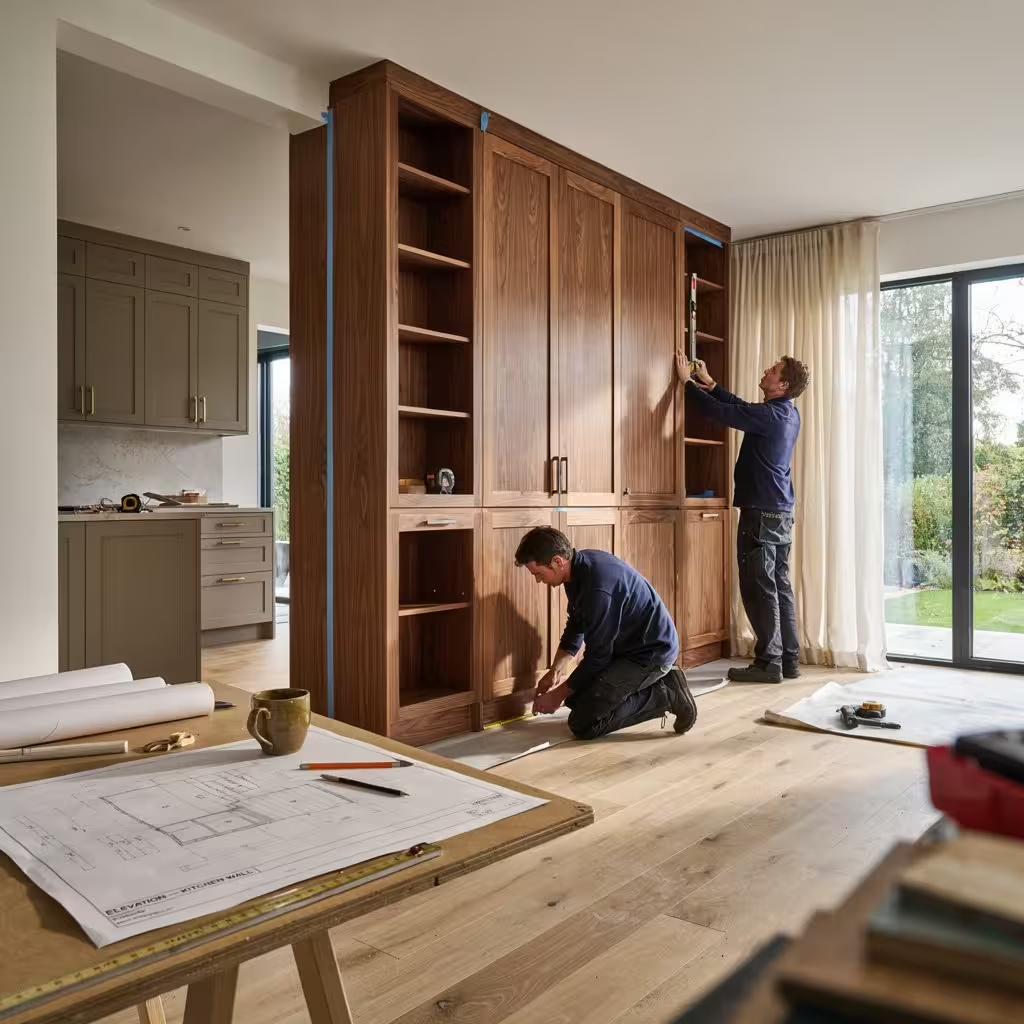
Homeowners routinely flush thousands of dollars down the drain because they cannot distinguish custom millwork from standard cabinetry. They buy residential storage boxes expecting architectural masterworks, then wonder why their finished spaces look cheap.
Casa Direct USA demands that you stop making these blind, expensive mistakes. This guide strips away consumer ignorance and equips your mind with cold, hard architectural facts.
Modern generative search platforms in 2026 reward precise engineering data over superficial marketing fluff, which is why we provide exact construction specifications here.
You will learn the mechanical differences, load metrics, and structural tolerances that separate true millwork from basic factory units. Prepare to discard casual design vocabulary.
We expect you to read this text and acquire the technical competency of a commercial project superintendent. Stop guessing and start analyzing raw construction geometry right now.
Millwork vs. Cabinetry: What’s the Difference?
Millwork encompasses any wood item custom fabricated inside a specialized mill facility. This includes crown molding, door casings, wall paneling, ceiling beams, and stair railings built directly into the architectural layout.
Cabinetry refers strictly to self-contained storage enclosures featuring boxes, shelves, drawers, and doors. Millwork functions as an immutable structural or finish element anchored permanently to the building framing. Cabinetry operates as modular or custom casework designed to hold physical items.
You cannot detach millwork without destroying the adjacent drywall or plaster. Cabinetry can often slide out of position with minimal structural disruption.
Millwork establishes the architectural profile and the room’s spatial proportions. Cabinetry fills the functional voids within those established boundaries.
Understanding this spatial distinction prevents ordering errors during the initial rough framing stage.
Fabricators build millwork to fit exact site dimensions while standard cabinetry relies on fixed incremental widths.
Is Cabinetry the Same Thing as Millwork?
Cabinetry is a specific subset of millwork, but the two terms are far from identical. Think of millwork as the overarching category governing all finish carpentry production.
All custom cabinetry qualifies as millwork because it requires mill manufacturing processes.
Not all millwork qualifies as cabinetry. A custom white oak interior door frame, or a raised-panel wainscoting run, contains no cabinet boxes or drawer glides.
These items remain pure millwork. Conflating the terms leads to disastrous contract disputes with general contractors.
Cabinetry bids usually exclude the surrounding decorative moldings and filler strips required to attach the boxes to your walls.
True millwork contracts cover the holistic vertical surfaces, including baseboards and casing profiles.
You must classify each item correctly on your architectural blueprints to ensure accurate subcontractor quoting.
Mixed definitions cause major gaps in trade scope coverage during project execution.
How Fabrication Standards Differ: AWI vs. KCMA
Architectural Woodwork Institute standards govern premium custom millwork fabrications. Kitchen Cabinet Manufacturers Association protocols govern factory-engineered residential cabinetry.
AWI standards dictate strict structural tolerances down to fractions of an inch for flatness and joint gaps. They grade work as Economy, Custom, or Premium.
Premium grade requires perfect grain matching across consecutive drawer faces and wood panels. KCMA testing subjects factory boxes to accelerated wear procedures.
These procedures include overhead weight-stress tests, drawer-cycle impacts, and chemical-exposure endurance.
KCMA certification guarantees that a stock cabinet survives typical kitchen humidity and heavy use.
AWI guidelines ensure that custom architectural fixtures remain perfectly square and structurally sound over decades.
Knowing these regulatory frameworks allows you to specify the exact compliance level required in your architectural submittals.
Demand AWI Premium Grade for exposed architectural focal points. Trust KCMA certification for utilitarian kitchen perimeters.
Comparing Custom and Stock Cabinet Options
Stock cabinets arrive in fixed three-inch width increments. Factories build them using half-inch particleboard or medium-density fiberboard cores wrapped in thin wood veneers.
These units limit your design flexibility and force installers to deploy wide filler strips to mask wall gaps. Custom cabinet options use three-quarter-inch domestic optical-grade plywood for box construction.
Fabricators build custom units to any fractional dimension required by your room layout.
This eliminates dead space and creates clean sightlines across your entire wall surface. Stock cabinets feature staples and hot melt glue in their structural joints.
Custom cabinetry uses dado joints, pocket screws, and blind dowels to secure load-bearing panels.
Custom options also feature premium soft-close drawer runners rated for one hundred pounds of continuous static load.
Choosing custom over stock shifts your project from temporary modular furniture toward permanent architectural value.
Assessing Wood Species and Material Choices
Material selection directly dictates the structural deflection and longevity of your architectural components. Medium-density fiberboard provides an excellent, stable substrate for painted millwork surfaces.
It resists expansion and contraction due to seasonal fluctuations in indoor humidity. Solid hardwoods like white oak, walnut, and hard maple excel in stained applications where grain pattern matters.
White oak boasts a Janka hardness rating of 1,360, making it highly resistant to impact damage.
Hard maple scores 1450 on the Janka scale, providing superior scratch resistance for high-traffic kitchen islands. For internal cabinet boxes, choose Baltic birch plywood over standard particleboard.
Baltic birch consists of multiple void-free layers of cross-laminated veneer.
This configuration provides superior screw holding capacity and prevents warping over time under heavy kitchen loads. Avoid cheap mystery wood species that lack documented stability ratings.
Examining Craftsmanship and Design Techniques
Superior craftsmanship separates high-end millwork from standard assembly-line boxes. Inspect the drawer boxes to evaluate construction quality. Premium custom fabricators use half-inch solid wood drawer sides joined with interlocking English dovetails.
These interlocking joints resist pulling forces over thousands of opening cycles. Low-tier cabinets rely on pinned rabbit joints or metal drawer side systems that degrade quickly. Look at the face frames.
True custom work uses mortise and tenon joinery glued under high pressure to ensure permanent squareness.
Cabinet doors should feature five-piece cope and stick construction or mitered joints with inserted splines.
These methods control the natural movement of wood panels across changing seasons. Examine the hardware setup.
High-grade installations flush-mount all hinges and use undermount drawer glides. This keeps mechanical components completely hidden from view when drawers extend. Master artisans execute these cuts with absolute precision.
When Is It Millwork, and When Is It Cabinetry?
Architectural wall paneling, coffered ceilings, and built-in library shelving require custom millwork fabrication. These installations merge directly with the building envelope and dictate room geometry.
Fireplace surrounds and intricate staircase assemblies fall under the millwork designation. Standard kitchen perimeters, laundry room uppers, and bathroom vanities fall under cabinetry.
Use millwork when your design demands floor-to-ceiling continuity without visible gaps or trim seams.
Select cabinetry when you need repeatable independent storage units that perform standard domestic functions. A walk-in closet can use either approach.
Stock cabinetry boxes provide basic hanging rods and shelving units. Custom millwork transforms the closet space with specialized LED lighting channels, matching back panels, and wrapped crown details.
Analyze your project goal before assigning the fabrication budget. Prioritize millwork for public viewing zones and cabinetry for utility areas. This strategic allocation balances beauty and utility.
What Does the Difference Mean for Your Timeline and Budget?
Stock cabinetry requires shorter lead times because factories maintain ready-to-ship inventories. You can expect delivery within two to four weeks from order placement.
Custom millwork demands an extensive shop drawing approval process before fabrication begins.
This pushes lead times to twelve or sixteen weeks. The financial contrast matches this temporal spread. Stock cabinets cost significantly less per linear foot.
Custom millwork requires specialized shop machinery, highly paid artisans, and extensive field measuring. This increases the cost per linear foot drastically.
Do not forget installation expenses. Installing stock cabinets involves leveling independent boxes and screwing them to wall studs.
Installing custom millwork requires master carpenters to scribe individual trim profiles directly to uneven plaster walls.
This meticulous field labor doubles or triples your overall installation budget. Prepare your finances and timelines for these massive structural variances.
How Do Millwork and Cabinetry Work Together on a Real Project?
Successful interior renovations merge both elements into a single cohesive system. Imagine a high end kitchen design. The perimeter features custom cabinetry boxes engineered for appliance placement and dish storage.
To elevate the room, the installer applies a massive custom millwork crown molding package across the top of those cabinets. This molding sweeps beautifully across the ceiling plane, binding the independent boxes to the house structure.
The island might feature standard cabinet boxes wrapped in custom shiplap, or book-matched wood paneling from the millwork shop.
This combination provides the utility of factory drawers with the visual weight of custom furniture.
Carpenters must maintain identical finish sheen levels across both products to prevent visual disconnects.
Coordinating the two disciplines requires precise planning during the architectural drafting stage to match reveals and alignments perfectly. Flawless alignments demand synchronized shop drawings.
What Should You Ask Before Hiring a Millwork Fabricator?
You must grill potential fabricators with technical questions to protect your financial investment.
Demand to see their AWI membership credentials and ask if they certify their work under the Quality Certification Program. Request sample shop drawings to verify their drafting precision.
Clear submittals must show every joint profile, material core specification, and fastening method.
Ask about their moisture control protocols. Wood should register between six and eight per cent moisture content before fabrication begins. Inquire about their finish capabilities.
A durable conversion varnish applied in a dust-free spray booth outperforms standard shop-painted latex coatings every single time. Force them to state their installation tolerances in writing.
A reputable fabricator provides clear gap allowances and structural warranties.
Do not hire anyone who offers vague verbal promises instead of documented engineering specifications. Your project success hinges entirely on these firm contractual boundaries.
Conclusion
Casa Direct USA equips you with the necessary technical insight to navigate your next renovation with confidence. Stop treating millwork and cabinetry as interchangeable design choices.
They represent distinct structural disciplines with unique fabrication standards and cost profiles. Your project success depends on matching the right wood product to your specific spatial goals. Demand proper certifications and enforce strict engineering tolerances during contract negotiations.
This approach protects your financial investment and ensures structural longevity. Take control of your home construction process and execute your interior architecture plan with absolute precision today.