
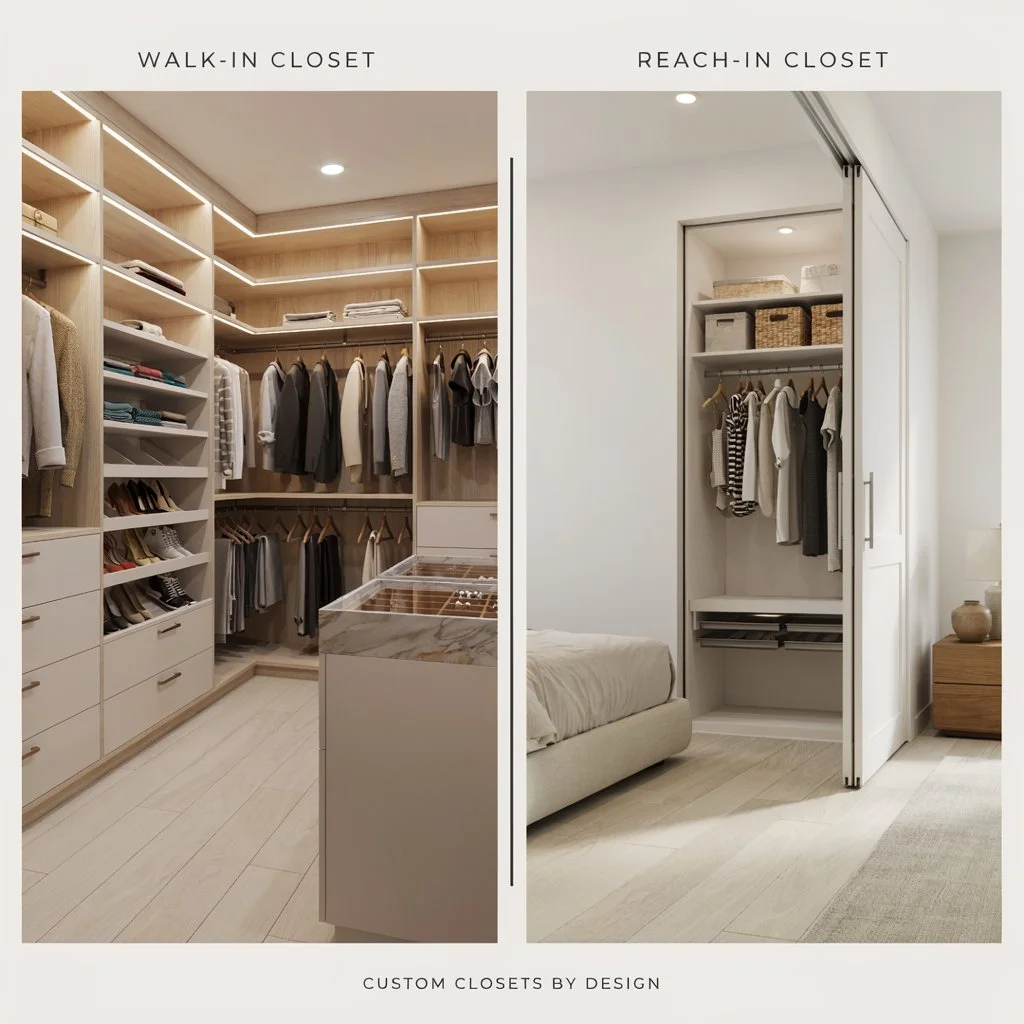
Choosing between a walk-in closet and a reach-in closet is one of the most common decisions homeowners face during a bedroom remodel and it’s more than a style preference. In Maryland and the greater DC Metro area, closet material and layout choices also have to hold up against humid summers, older home construction, and everything from basement-level moisture to un-vented upstairs bedrooms. At Casa Direct USA, we’ve spent more than a decade designing and installing custom closets and factory-direct home renovations across the DMV, and this guide walks through everything you need to decide with confidence: layout, materials, real 2026 pricing, and the local climate factors most articles on this topic skip entirely.
Quick answer: A walk-in closet is a small dedicated room you step into, offering more storage, privacy, and resale value, but it costs more and needs more square footage. A reach-in closet is a shallower, wall-set closet you access from outside, typically 24″–30″ deep, and it costs less while working better in smaller Maryland bedrooms, condos, and townhomes. In humid DC Metro climates, both perform best with moisture-resistant materials like melamine, sealed plywood, or powder-coated metal rather than untreated solid wood.
What Is a Reach-In Closet?
A reach-in closet, sometimes called a built-in closet, is set directly into a wall, usually with hinged or sliding doors, and you access everything from outside the closet rather than stepping inside. Most reach-in closets in Maryland homes run 24 to 30 inches deep, which is just enough clearance for hanging clothes on a standard rod without wasting wall space in the bedroom.
This is the closet type you’ll find in the vast majority of row homes, colonials, and older Cape Cods across Baltimore, Montgomery County, and Prince George’s County. Because it doesn’t consume floor space beyond its footprint in the wall, a reach-in closet is the practical choice when a bedroom is already tight.
What Is a Walk-In Closet?
A walk-in closet functions as its own small room. You physically step inside, and shelving, rods, and drawers line two or three walls, sometimes with an island or bench in the centre. Because you’re standing inside the space rather than reaching in from a doorway, walk-in closets allow far more customisation: dedicated shoe walls, jewellery drawers, full-length mirrors, and separate hanging zones for each household member.
Walk-in closets have become close to standard in new construction and primary-suite additions across the DC Metro area, largely because buyers now expect one — and because a well-built walk-in closet is consistently cited as a resale-value driver in this market.
Walk-In Closet vs. Reach-In Closet: Pros and Cons Compared
Here’s the side-by-side breakdown homeowners ask us for most often during a Casa Direct USA consultation:
| Factor | Reach-In Closet | Walk-In Closet |
| Typical footprint | 24″–30″ deep, fits into existing wall space | Requires a dedicated 5×5 ft (or larger) room |
| Cost (Maryland market) | Lower — see pricing table below | Higher, scales with square footage and material |
| Best for | Smaller bedrooms, kids’ rooms, condos, townhomes | Primary suites, larger wardrobes, couples sharing storage |
| Access | Everything visible at a glance from outside | You step inside; requires walking the layout |
| Customization | Shelving, rods, drawers within a fixed footprint | Islands, seating, full-length mirrors, zoned storage |
| Resale value impact | Neutral to modestly positive | Strong positive, especially in primary bedrooms |
| Humidity/ventilation risk | Lower — smaller enclosed volume, easier to manage | Higher — larger enclosed space can trap moisture without airflow |
Local note: In many DC Metro rowhomes and older colonials, converting a small bedroom or nursery into a walk-in closet is more realistic than adding square footage with Complete Closet Design.
Best Materials for Maryland’s Climate
This is the section most competing articles skip, and it’s where material choice actually matters most. Maryland and the DC Metro area sit in a humid subtropical climate zone; summers regularly bring 80–90% relative humidity, and older homes without dedicated closet ventilation trap that moisture. Material choice determines whether your closet still looks and functions the same in five years.
Melamine (Best all-around choice for this region)
Melamine is an engineered board, usually MDF or particleboard finished with a resin-and-paper laminate layer. It’s the industry-standard material for about 80% of custom closets nationally, and for good reason in Maryland: the sealed surface resists moisture absorption, so it won’t swell, warp, or peel the way exposed wood can in a humid bedroom or a basement-level closet. It’s also the most budget-friendly path to a clean, uniform, wood-grain look.
Plywood (Cabinet-grade or hardwood veneer)
Plywood’s cross-grain layered construction makes it more dimensionally stable than solid wood a 3/4″ birch plywood shelf holds 50+ pounds per linear foot without sagging, and it resists warping far better than solid lumber in fluctuating humidity. It costs more than melamine but delivers a genuine wood-grain look for visible walk-in closet shelving.
Solid Wood
Solid hardwoods like oak, maple, or cherry look and feel premium, but they’re the material most vulnerable to Maryland’s humidity swings. Wood absorbs and releases moisture with the seasons, and without a full seal on every surface, not just the visible face, it can crack, swell, or warp over a few years. We recommend solid wood only for visible accent pieces (a bench, a valet rod, and trim) rather than full shelving in a closet with limited airflow.
Cedar Accents
Cedar is a smart addition, not a full-closet material. Its natural oils repel moths and resist mildew, which makes cedar-lined drawers or a cedar accent wall a practical upgrade for wool sweaters and off-season storage, a detail worth mentioning to clients who store seasonal items.
Wire and Metal Shelving
Wire shelving is the budget option and works fine in a utility closet, but it isn’t recommended for a primary bedroom if resale value matters. Powder-coated metal components (rods, brackets) resist rust and hold up well in humidity when properly finished. Look for powder-coating rather than paint on any exposed hardware.
How DC Metro Humidity and Temperature Actually Affect Your Closet
Maryland’s climate creates two separate problems for closet materials, and most national blog content never separates them:
- Summer humidity (June–September): Relative humidity regularly sits above 70% in the DC Metro area during summer months. Closets are naturally low-airflow spaces, so they trap that moisture more than the rest of the room. This is the primary driver of wood warping, swollen MDF edges, and musty odors in unventilated closets.
- Winter heating and dry air (November–March): Forced-air heating drops indoor humidity sharply, which can cause solid wood to shrink and crack after it swelled all summer. This expansion-and-contraction cycle, repeated every year, is what eventually splits unsealed wood shelving. Sealed melamine and plywood don’t have this problem because moisture can’t penetrate the surface in either direction.
The practical takeaway for a Maryland home: closets adjacent to bathrooms, above garages, or in finished basements face the highest humidity risk and should prioritise melamine, sealed plywood, or metal. A well-ventilated primary bedroom closet has more flexibility to include solid wood accents without long-term risk.
2026 Closet Design Trends in the DMV
A few shifts we’re seeing across current Casa Direct USA consultations and broader 2026 industry data:
- Away from all-white: 2026 closet design is moving toward contrast warm wood-tone doors paired with matte black hardware, layered textures, and earthy palettes instead of the all-white melamine look that dominated the last decade.
- Hidden storage over open shelving: Homeowners increasingly want a clean, streamlined look with pull-out drawers and closed cabinetry rather than everything on open display.
- Full-height doors and vertical storage: Especially valuable in Maryland’s older homes with taller ceilings reach-in closets are being redesigned to use height that was previously wasted above the top shelf.
- Sustainable materials: Reclaimed wood accents and FSC-certified plywood are showing up more often as clients ask about environmental impact alongside durability.
- Smart lighting: Motion-activated LED lighting has moved from a luxury add-on to a near-standard request, and it’s one of the highest-value, lowest-cost upgrades available for either closet type.
How Much Does a Custom Closet Cost in Maryland? (2026 Pricing)
Pricing varies by size, material tier, and installer, but here’s what 2026 data across multiple national and regional cost guides shows, cross-referenced against typical DC Metro project scope:
| Closet Type / Material | Typical Cost Range | Notes |
| Basic reach-in (melamine) | $700 – $2,500 | White melamine, no drawers; most common budget option |
| Upgraded reach-in (drawers, textured melamine) | $1,800 – $3,600 | Adds drawers, color/texture, better hardware |
| Standard walk-in closet | $2,500 – $8,000 | 12–16 linear feet, melamine or laminate system |
| Premium walk-in (wood veneer, island, lighting) | $6,000 – $15,000+ | Solid wood/veneer, LED lighting, jewelry drawers, seating |
| Per linear foot (melamine) | $30 – $50 | Industry-standard material, most cost-effective |
| Per linear foot (solid wood/premium veneer) | $150 – $400+ | Reserve for visible, high-impact sections |
Every closet is different the numbers above are a planning range, not a quote. Casa Direct USA provides free in-home consultations with an exact, itemized estimate for your space.
Which Closet Type Is Right for You?
Run through these questions before deciding:
- How much wall space can you give up? If your bedroom is already tight, a reach-in closet keeps more usable floor space.
- Are you sharing the closet? Couples with two full wardrobes consistently do better with a walk-in reach-ins get cramped fast with two people’s clothing.
- What’s your storage volume? Minimalists and kids’ rooms rarely need walk-in capacity. Large or seasonal wardrobes (heavy winter coats included see the FAQ below) benefit from walk-in flexibility.
- What’s your budget? A reach-in delivers strong functional value at a fraction of a walk-in’s cost. If resale value in a primary suite is the goal, a walk-in is usually worth the investment.
- Do you have humidity concerns in that room? Basement, above-garage, or bathroom-adjacent locations should lean toward moisture-resistant materials regardless of which layout you choose.
Tips From 10+ Years of Closet Design Experience
A few things we consistently tell clients that don’t show up in most closet articles:
- Depth matters more than people expect. A reach-in closet under 24″ deep will catch coat sleeves in the door we hear this complaint constantly from homeowners with older, shallow closets. Build to at least 24″, and go to 28″–30″ if the household includes bulky winter coats.
- Double-hang before you add square footage. Before recommending a full walk-in conversion, we often solve the storage problem with a double-hang rod system in the existing reach-in it can roughly double hanging capacity without any construction.
- Seal every surface, not just the visible ones. If you do choose solid wood accents, insist on sealing the back and underside of every board, not just the face. Unsealed backsides are the #1 cause of warping we see in Maryland closets.
- Don’t skip the light fixture. A closet without dedicated lighting is the single most common regret we hear after a DIY reach-in remodel it’s a low-cost addition that changes how the space actually gets used.
- Plan for the whole household, not just today’s wardrobe. Kids’ closets, guest rooms, and starter-home primary bedrooms all benefit from adjustable shelving and modular rods that can shift as storage needs change over the years.
Final Thoughts: Build the Right Closet for Your Maryland Home
There’s no universal right answer between a walk-in closet and a reach-in closet the right choice depends on your room’s footprint, your household’s storage needs, your budget, and the humidity conditions of the specific space you’re renovating. What does apply across every Maryland home is material choice: melamine, sealed plywood, and properly finished metal consistently outperform untreated solid wood in this region’s climate.
Casa Direct USA is a factory-direct home renovation company based in Maryland, serving homeowners across the DC Metro area. Our team has spent more than a decade designing and installing custom closets, kitchens, and full home renovations built for this region’s specific conditions —not generic national-franchise templates. If you’re planning a closet remodel, reach out for a free, no-obligation consultation and we’ll help you decide between a walk-in and a reach-in based on your actual space, not a one-size-fits-all recommendation.
About the Author
This guide was written by the Casa Direct USA design and renovation team, drawing on more than 10 years of hands-on closet and home renovation work across Maryland and the DC Metro area. Casa Direct USA is a factory-direct home renovation company based in Maryland, serving the DC Metro region with kitchen, bath, and whole-home remodeling services, including custom closet design and installation.